


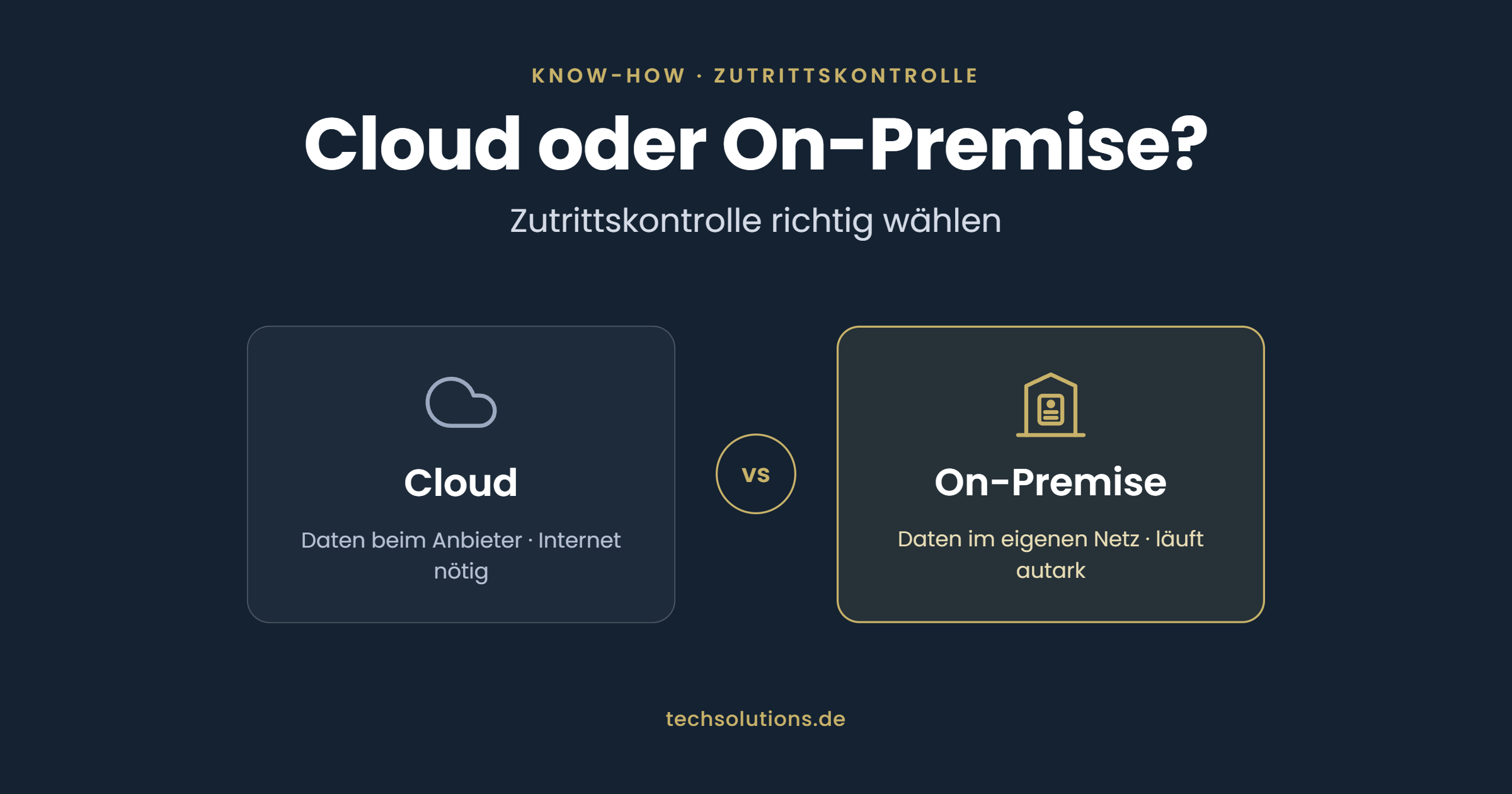
With every new access control system, a fundamental question arises early on: Where do the system and the data run—in the cloud with the provider or in the own building (On-Premise)? The answer determines who controls the data, whether the system works without an internet connection, and what costs accrue over the years. This article explains both approaches, compares them, and shows which models are suitable for which objects.
Cloud access control: management via the provider's data center
With a cloud solution, readers and building control are located at the provider; however, the software and database are hosted by the provider. Authorizations, time profiles, and event logs are managed via the Internet and stored in the provider’s data center.
Strengths
- Access from anywhere, e.g. for companies with many distributed locations
- No own server hardware and no operation of a database on site
- The provider plays a central role in the updates
Boundaries
- A stable internet connection is required for administration and synchronization.
- The data is located outside of the company's own premises; the storage location, access rights, and order processing must be clearly defined in the contract.
- Most ongoing fees per door, user, or location – costs grow with the system
- Dependence on the provider: If they change prices or terms, switching is complicated
On-Premise: The system runs in the own building
With On-Premise, the complete access control is located on-site: the control, the software, and the data. It is managed within the own network; the data leaves the premises only when the operator explicitly requests it.
Strengths
- Full data sovereignty: Personal, authorization, and event data remain within the own network
- Works regardless of the Internet – even in the event of disruptions at the provider
- Costs are one-time and predictable, instead of permanent subscription fees
- Reduced attack surface because the system does not have to be permanently accessible from the Internet
Boundaries
- Operation, updates, and data backup are the responsibility of the operator or the developer.
- Remote access from outside requires a deliberately configured, secure connection (e.g., VPN)
Traditional on-premise systems often require a dedicated server with a database and PC software. Modern systems move the management directly to the controller – eliminating this hassle.
Cloud and On-Premise Compared Head-to-Head
| Criteria | Cloud | On-Premise |
|---|---|---|
| Location of data storage | Provider's data center | In your own building, in your own network |
| Internet connection | Permanently necessary for administration | Not required |
| Cost model | Ongoing fees per door, user, or location | Unique investment |
| Remote access | Standardly from anywhere | Only through deliberately designed, secure access |
| Updates and operation | By the provider | By the operator or developer |
| Dependence | From the provider and its infrastructure | Low; system runs autonomously |
| Data protection (GDPR) | Contractual regulation of order processing and storage location | Data remain under your own control |
What NIS2 means for your access control is shown in our Checklist for NIS2 and access control.
Which model fits which object?
There is no „always better“ – the requirements of the object are decisive. These questions help with the classification:
On-premises is usually the better choice when…
- Data sovereignty and data privacy are particularly important, e.g. in industry, public administration, healthcare or critical infrastructure
- the building must remain fully functional even in the event of an internet outage
- The IT security policy does not allow permanent connections to the Internet
- the costs should be predictable over many years
Cloud can be useful if…
- many small, distributed locations are to be managed centrally
- There is no IT infrastructure on site and no contact person for operation
- Remote management on the go is the most important requirement
Hybrid: Many operators want both – a system that runs locally autonomously and, if needed, has a cloud connection for remote access. What is crucial is that the cloud remains an option and is not a prerequisite.
The TechPoint-Approach: On-Premise as the standard, Cloud as an option
TechPoint combines the advantages of on-premises with a lean architecture. The complete access management is located directly in the controller and is operated via the web browser – without external PC software and without a separate database.
- Data remain in the house: Permissions and events are managed in the controller within the own network
- Works without internet: The system operates autonomously within the local network.
- No ongoing license fees for the operation of the system
- Always connected to the network: IEEE 802.1X, TLS 1.3, HTTPS, IP filtering and password-protected user levels
- Definitely at the door: Reader connection via OSDP 2.0 with AES-128 encrypted Secure Channel
- Scalable: Up to 64 TechPoints can be networked in a cluster (1 master, 63 slaves)
Anyone who needs remote access or mobile connectivity can optionally expand TechPoint. The cloud is thus an option – not a requirement.
Conclusion
Cloud and on-premise are not matters of belief, but rather architectural decisions. Those who need data sovereignty, independence from the internet, and predictable costs generally prefer on-premise solutions. Ideally, a system that runs locally autonomously and can be expanded to connect to a cloud when needed is ideal.
Are you planning a project or would you like to get to know TechPoint? We support developers, planners and operators in selecting the appropriate architecture.
TechSolutions Germany GmbH · Im Hohtal 1 · 78120 Furtwangen Phone: +49 171 1256163 · E-mail: info@techsolutions.de · techsolutions.de
TechPoint: On-Premise access control without cloud compulsion
Administration in the controller, no server, no cloud obligation. Get to know TechPoint in the free product webinar on November 30, 2026 at 10:00 a.m.