


Since December 6, 2025, the NIS2 Implementation Act has been in effect in Germany. Many companies first think of firewalls, backups, and phishing training. However, access control is also an interconnected IT system – and anyone physically present in the building is often quickly connected to the network.
This article shows what NIS2 means for building security and what a consistently secured chain from the card to the network looks like.
NIS2 in Germany: What applies now?
The NIS2 Implementation Act (NIS2UmsuCG) was announced on December 5, 2025, and has been in effect since December 6, 2025 – without a transition period. At its core is the newly drafted BSI Act (BSIG). The number of affected companies thus rises from approximately 4,000 to over 29,000, including many medium-sized businesses.
| Classification | Typical thresholds |
|---|---|
| Particularly important facility | Sector according to Annex 1 BSIG and usually at least 250 employees or more than €50 million in revenue and more than €43 million in balance sheet total |
| Important facility | Sector according to Investment 1 or 2 of BSIG and usually at least 50 employees or more than €10 million in revenue and balance sheet total |
Affected companies had to register with the BSI by March 6, 2026. Significant security incidents must be reported in stages: a first report within 24 hours, a detailed report within 72 hours, and a final report within one month.
The management is responsible. They must implement, monitor and document the risk management measures and participate in regular training sessions. Violations can be punished with significant fines.
The minimum measures under § 30 BSIG are based on a cross-sectoral approach. Particularly relevant for building safety are:
- Concepts for the safety of personnel, which Access control and the management of ICT systems (No. 9)
- Concepts and processes for deployment Cryptographic methods (No. 8)
- Security of the supply chain (No. 4)
- Safety at Acquisition, development and maintenance from IT systems (No. 5)
- Authentication and secure communication (No. 10)
Why access control is included in the NIS2 risk analysis
Today, access control is an interconnected IT system: Controllers are embedded in the corporate network, readers communicate with the control system, and identification cards provide identity. Each of these points can be a potential entry point.
- Copyable IDs: Older card technologies can be read and cloned with inexpensive hardware.
- Unsecured reader lines: The widely used Wiegand protocol transmits data unencrypted. Anyone who gets to the line behind the reader can intercept or read the data.
- Controllers in the network: A poorly secured controller can serve as the entry point into the corporate network.
- Physical access = digital access: Anyone who is unauthorized in the building can access server rooms, network drives, and workstations.
NIS2 therefore does not require a single measure, but a comprehensive concept. Access control is only as secure as its weakest link.
Read our comparison to learn why the location of the access data for NIS2 is important. Cloud or On-Premise.
The secure chain: from the ID card to the network
Secure access control protects every link and every connection between them. If one link fails, the entire chain is vulnerable.
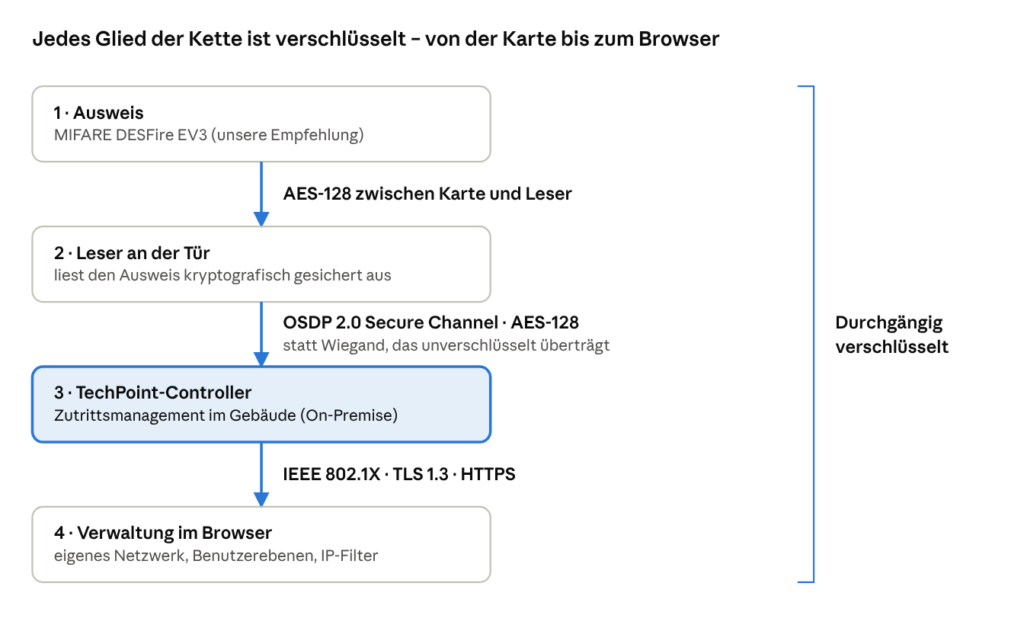
1. ID card. Modern cards such as MIFARE DESFire EV3 secure communication with the reader using AES-128 and cannot be easily copied. Importantly, the readers read the card using customer-specific keys and not just the serial number (UID).
2nd reader → Controller. OSDP 2.0 is the open standard for reader connectivity. With active Secure Channel, communication is encrypted with AES-128, and the connection is monitored—any tampering is detected.
3. Controller in the network. With IEEE 802.1X, only authenticated devices are allowed to connect to the network. IP filters limit who can actually reach the controller.
4. Administration. It is accessed via the web browser using HTTPS and TLS 1.3. Password-protected user levels ensure that only those who are authorized can see and change what they are allowed to do.
Checklist for operators and developers
With these questions, you can check whether your access control fits into the NIS2 strategy:
- Is access control part of the risk analysis and security concept?
- Are outdated, copyable technology still being used for ID cards?
- Do the readers communicate via Wiegand or via OSDP using Secure Channel?
- Are the reader keys custom-made and securely managed?
- Do the controllers authenticate themselves on the network, e.g. via IEEE 802.1X?
- Is the administration encrypted (HTTPS, TLS 1.3) and restricted to authorized users?
- Where are the access data located – on the company’s own network or with a third-party provider?
- Is there a process for firmware updates and the handling of vulnerabilities?
- Is the manufacturer or supplier included in the evaluation of the supply chain?
- Are the measures and configuration documented in a way that they can be proven to inspectors?
So it works TechPoint the secure chain around
| Link in the chain | Risk without protection | Implementation with TechPoint |
|---|---|---|
| ID card | The card is read and cloned | Recommendation: MIFARE DESFire EV3 with AES-128 |
| Reader → Controller | Data is sampled or recorded on the line (Wiegand) | OSDP 2.0 with Secure Channel, AES-128 encrypted, line monitored |
| Controllers in the network | Unauthorized devices on the network, access via the controller | IEEE 802.1X, IP filtering |
| Administration | Read access data, unauthorized operation | Web browsers over HTTPS and TLS 1.3, password-protected user levels |
| Data retention | Dependence on external services | On-Premise: access management in the controller, data on your own network; cloud only optional |
Important: A product alone does not make a company NIS2 compliant. The responsibility for risk analysis, measures, and documentation lies with the management. However, a consistently secured architecture makes implementation much easier and makes it possible to clearly document compliance.
Conclusion
NIS2 does not end at the server room. Anyone who incorporates access control into their risk analysis and secures every link in the chain – credentials, readers, controllers, and network – closes a frequently overlooked gap. DESFire EV3, OSDP 2.0 Secure Channel, IEEE 802.1X, and TLS 1.3 form a continuously encrypted chain from the card to the browser.
Do you want to align your access control with NIS2? We advise developers, planners and operators on the appropriate architecture.
TechSolutions Germany GmbH · Im Hohtal 1 · 78120 Furtwangen Phone: +49 171 1256163 · E-mail: info@techsolutions.de · techsolutions.de
Note: This article is for general information purposes only and does not replace legal advice. Whether and to what extent a company falls under NIS2 should be examined on a case-by-case basis.
Sources
- Section 30 BSIG – Risk management measures (gesetze-im-internet.de)
- Heuking: NIS2 implementation law comes into force
- Ebner Stolz: NIS-2 in Germany – the new BSIG is in effect
TechPoint: On-Premise access control without cloud compulsion
Administration in the controller, no server, no cloud obligation. Get to know TechPoint in the free product webinar on November 30, 2026 at 10:00 a.m.